
6 Surefire Ways to Improve Your Hiring Hit Rate

The Big Idea
Hiring is hard. But most hiring mistakes aren’t bad luck. They’re the predictable result of loose, instinct-driven interviewing and a weak hiring process. A disciplined, structured process is the single highest-leverage way to raise your hiring hit rate and protect value creation. If you want to improve your hiring hit rate and achieve better talent outcomes, start with these 6 actionable ideas.
I have a confession: Earlier in my career, I used to think I was amazing at interviewing. Like… Jedi-level good. Then, as the hiring mistakes started to stack up, I realized something humbling: “Ah… so that’s what overconfidence looks like.”
Hiring is funny like that. It’s kind of like driving or karaoke: we all think we’re above average. “I’m a great judge of talent!” most leaders will say (or at least think to themselves).
Meanwhile, the data taps us gently on the shoulder and tells a different story. Research shows that nearly 50% of new hires fail within 18 months.
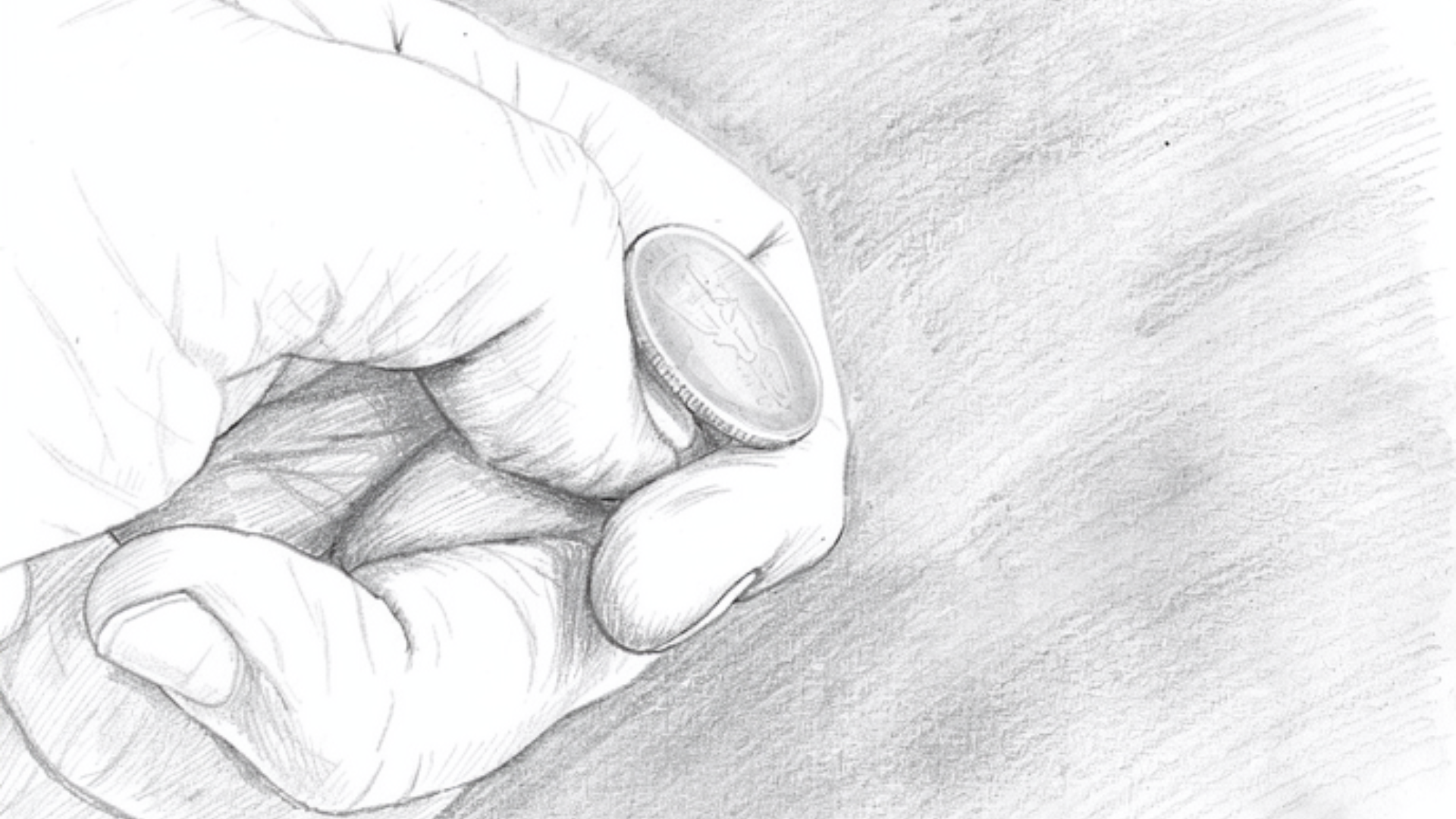
Let that sink in. If half your PE deals were bagels, or if your sales team hit quota every other year, no one would call that acceptable. Yet in hiring, many leaders shrug and move on. We treat it as inevitable. A cost of doing business. It shouldn’t be.
THE MISHIRE TAX
In the 50% of cases where new hires don’t work out, what’s the cost? In a word: astronomical. A bad hire can cost your company 3x to 15x that role’s annual salary once you factor in things like replacement costs, lost time, missed opportunity, and collateral damage to your team.
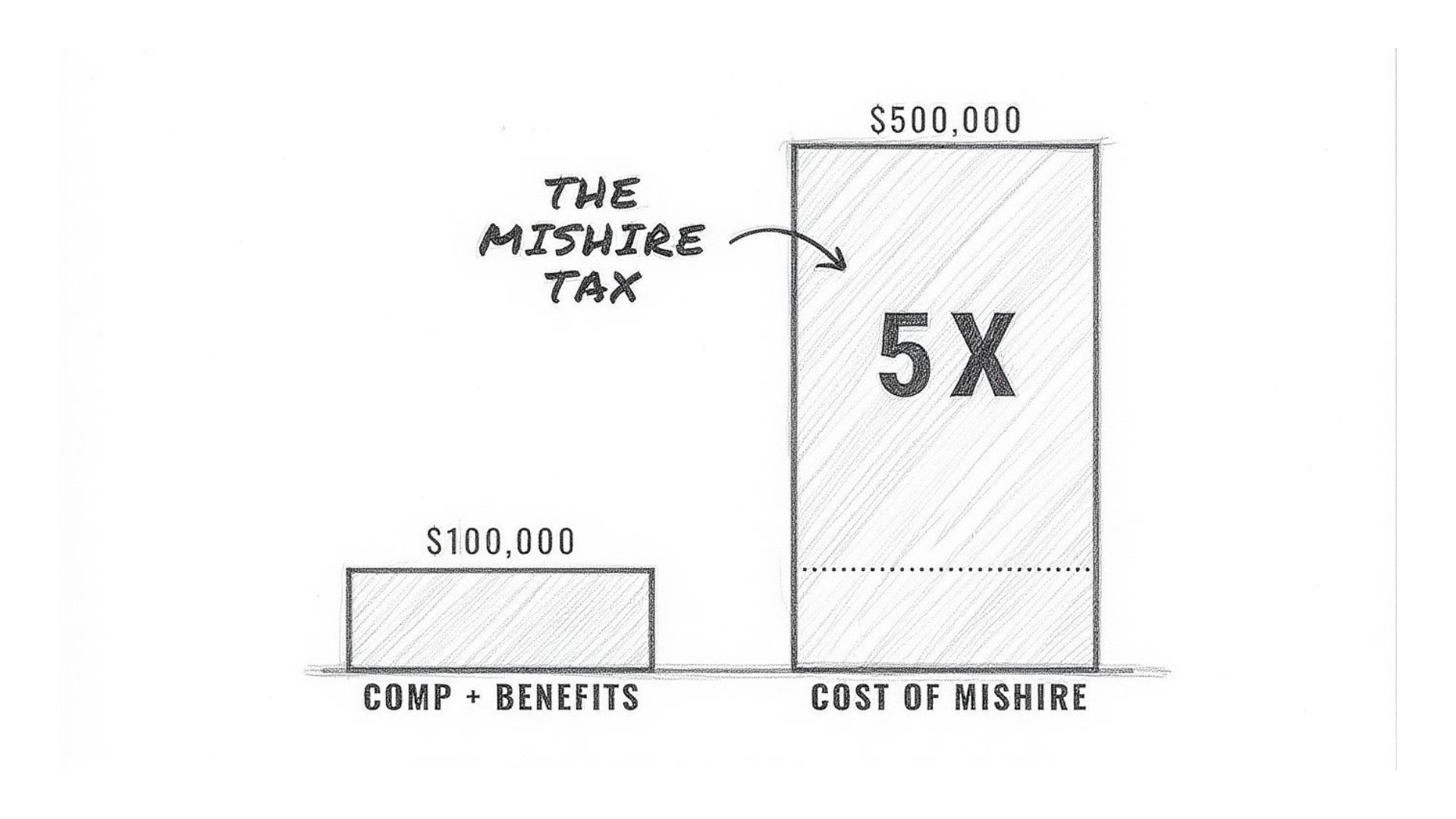 In private equity, that “mishire tax” cuts directly into returns. I’ve paid it. If you’ve been hiring and leading long enough, you’ve surely paid it. And most of us keep paying it far longer than we'd like to admit, clinging to the delusion that our "excellent instincts for talent" put us above the data. (Spoiler: they probably don't.)
The mishire tax isn’t bad luck. It’s the predictable byproduct of weak, seat-of-the-pants interviewing and an unstructured hiring process. But it doesn’t have to be that way. Hiring is hard, but here are six surefire ways to improve your hiring hit rate by tightening up your interview discipline:
- Don’t wing it. Be prepared.
- Have a process and follow it.
- Build and use a scorecard.
- Ask better questions.
- Understand your biases.
- Remember: it’s a two-way street.
Don’t wing it. Be prepared.
Winging it is fine for freestyle rapping, impromptu speaking, or placing an order at Buffalo Wild Wings. But not when millions of dollars' worth of enterprise value hangs in the balance.
When you walk into an interview unprepared—skimming the résumé five minutes beforehand and making up questions on the fly—your brain does what it’s wired to do: it defaults to shortcuts. In the absence of preparation and structure, bias rushes in to fill the gap. Overrelying on first impressions. Following gut instincts. Defaulting to snap judgments. Making up random interview questions that aren’t actually predictive of on-the-job performance.
Being prepared isn’t hard, and its benefits are quite obvious. But in the fast-paced, always-busy environment in which PE leaders operate, it turns out common sense isn’t always common practice. This one just requires some intention. Start here.
Have a process and follow it.
The leaders who hire best don’t improvise. They follow a consistent, disciplined process. This usually includes things like:
- Interviewer training. Your team gets trained on structured interviewing, legal compliance, bias awareness, and how to use your evaluation tools consistently.
- One clear owner. One person serves as the quarterback of the search from kickoff to final decision.
- Defined interview flow. Each interview has a distinct purpose: a top-of-funnel screen, a role-specific deep dive, a behavioral interview focused on past performance. Interviews are not redundant and build on each other.
- Structured debrief meetings. After each candidate completes interviews, the team meets to share evidence-based feedback, surface concerns, and make decisions while the data is fresh.
- Independent written feedback. Everyone involved in these debriefs submits their assessment before any group discussion to minimize groupthink.
Hiring mistakes rarely come from bad intentions. They arise from having no system. So develop a clear hiring process (it doesn’t have to be complex), and get everyone involved aligned on it. W. Edwards Deming said it well, “If you can’t describe what you are doing as a process, you don’t know what you’re doing.
Build and use a scorecard.
In private equity, you'd never evaluate an acquisition without a due diligence checklist. Yet many leaders evaluate candidates without anything equivalent.
Without agreed-upon criteria for evaluating candidates, each interviewer brings their own mental model of the "right" candidate, shaped by their preferences, biases, and assumptions. One person prioritizes technical depth, another focuses on leadership presence, and a third overvalues charisma and underweights substance.
A scorecard can help fix that. It objectively articulates what success in the role requires: the three to five outcomes the role must deliver, and the skills and attributes necessary to achieve those outcomes.
In teams I've led, we’ve implemented a simple rule: No job posting, no interviews, and no budget approval until we first aligned on the scorecard. The logic was straightforward: until we agree on the scorecard, we don't actually know what we're hiring for. And if we aren't aligned on what we're hiring for, how will we know when we've found it?
A scorecard forces the team to align on what matters most before anyone meets a single candidate. It creates a shared standard, a common language, and clear criteria that everyone evaluates against.
If you're looking for a quick way to improve your hiring hit rate, start here. Create a clear, objective scorecard to assess candidates against. It's not fancy, but it works.
Ask better questions.
The real purpose of interviewing isn’t to have a pleasant conversation. It’s to gather data. Not opinions. Not hypotheticals. Data.
Past behavior remains the strongest predictor of future performance. Which means your primary job in an interview is to dig into a candidate's history and draw out data: concrete examples of the actions they took, the decisions they made, and the actual business impact of those actions and decisions.
The problem is, most interview questions don't do that. "What's your biggest weakness?" or "How would you handle conflict on your team?" These invite speculation or rehearsed answers. They generate noise, not signal.
Strong interview questions share four qualities:
- Open-ended — they draw out commentary, not a yes/no.
- Non-leading — they avoid signaling the “right” answer.
- Fact-seeking — they probe for what actually happened and what the candidate actually did.
- Performance-oriented — they tease out actual performance data in areas relevant to your scorecard.
For example, instead of asking, "How would you lead a turnaround?" ask: "Tell me about the turnaround you led in 2022 at ABC Inc. What steps did you take, what obstacles did you face, and what was the outcome?" One invites speculation. The other extracts data.
Understand your biases.
The biggest threat to a good hiring decision isn’t the candidate across the table. It’s the unconscious, unexamined assumptions we carry into the room.
Our brains are wired to rely on mental shortcuts — what psychologists call cognitive biases. These make us more efficient in daily life, but they work against us in interviews, distorting what we see, how we listen, and what we conclude.
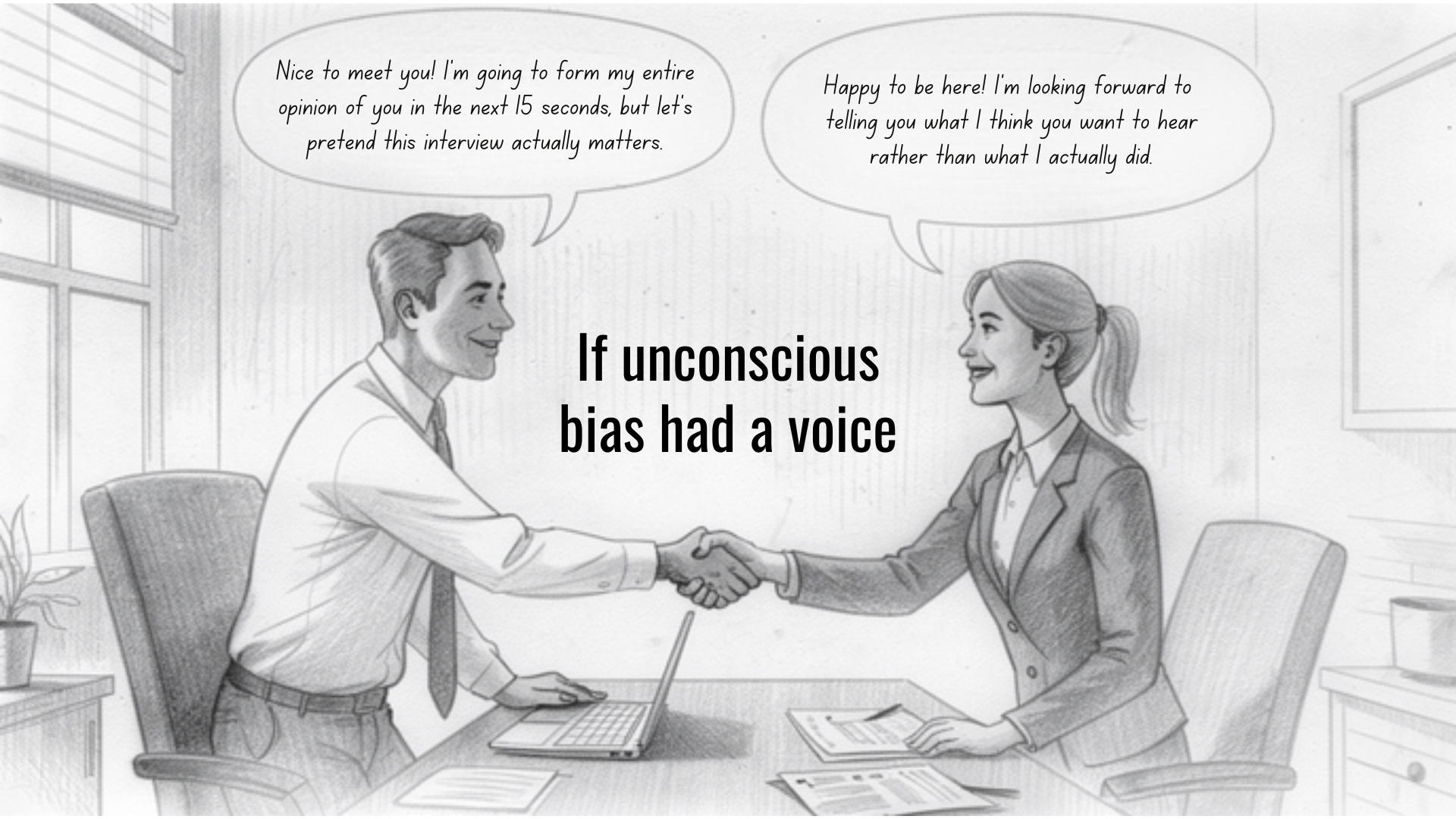
A few of the most common and costly cognitive biases that show up in the interview process:
Affinity bias: Favoring candidates who are similar to you. When someone reminds us of ourselves, we’re more likely to like them, and unconsciously overweight that likeability in our evaluation.
Confirmation bias: Deciding early, then looking for evidence to support it. Most interviewers form an impression in the first few minutes and spend the rest of the conversation seeking evidence that justifies it.
Bandwagon bias: Taking your cues from others rather than from the data. When the team already “likes” a candidate, it is harder to stay objective and maintain independent judgment.
The goal isn’t to eliminate bias — no one can. The goal is to become acutely aware of it and design the process to reduce its effect. Build interview teams with diverse perspectives. Require written assessments before any group discussion. Look intentionally for disconfirming evidence — not just the data that fits your early impression.
Remember: it’s a two-way street.
One of the realities leaders often overlook is that strong candidates are evaluating you just as carefully as you’re evaluating them.
In the PE ecosystem especially, the best operators, functional leaders, and domain experts have options. They aren’t choosing between one role and unemployment. They’re choosing between you and another attractive opportunity.
If your interview process feels transactional, rushed, or interrogative, it sends a message you probably don’t want to send. That’s why every interview needs to have two jobs: to evaluate the candidate (the “buy”); and to earn the candidate’s confidence (the “sell”). Most hiring managers are plenty focused on the first, but much less focused on the second.
One way to win over top talent is to listen closely in early conversations for what matters most to the candidate. Is it growth opportunity? Culture? Autonomy? Compensation? People? Once you know what matters to them, use the rest of the process to connect the dots between what they care about and what the role offers. Show them the scope they’ll own, the problems they’ll tackle, and the people they’ll work alongside.
And don’t underestimate the value of small touches. Timely and transparent follow-up. Having their favorite snack or beverage waiting when they arrive. Encouraging team members to pop in and say hello. These things may seem minor, but together they send a powerful signal: this is a place that pays attention, respects people, and sweats the details.
THE BOTTOM LINE
Hiring doesn't have to be a coin flip. When you bring the same discipline to hiring that you bring to other aspects of your job, your hit rate will improve. And when your hiring hit rate improves, everything else gets easier.